
Medieval Edwardsons: 1397-1443
By Mike Edwardson
My surname, Edwardson, is at once very ordinary – you’ll win no prizes for working out it’s meaning – but also extremely rare. The Anglo-Saxon world is full of Thompsons, Richardsons, Williamsons and indeed Edwards’s; but Edwardsons are hard to find (the 1891 census recorded just 391 Edwardson families but more than 82,000 named Edwards). In an ongoing quest to uncover why this should be, I saddled up my figurative horse and rode forth to the MedievalSoldier.org. Would there be any evidence of my ancestors from the days when life revolved around the harvest, longbowmen practiced their art at the butts of a Sunday and Chaucerian characters cavorted in taverns up and down the land?
The short answer is – yes, there is some Edwardson evidence from the latter end of the Middle Ages. It leaves us with little ideas as to why the name is so rare – but does suggest some interesting theories that take us as close to the origins of the Edwardson name as we can, perhaps, hope to get.
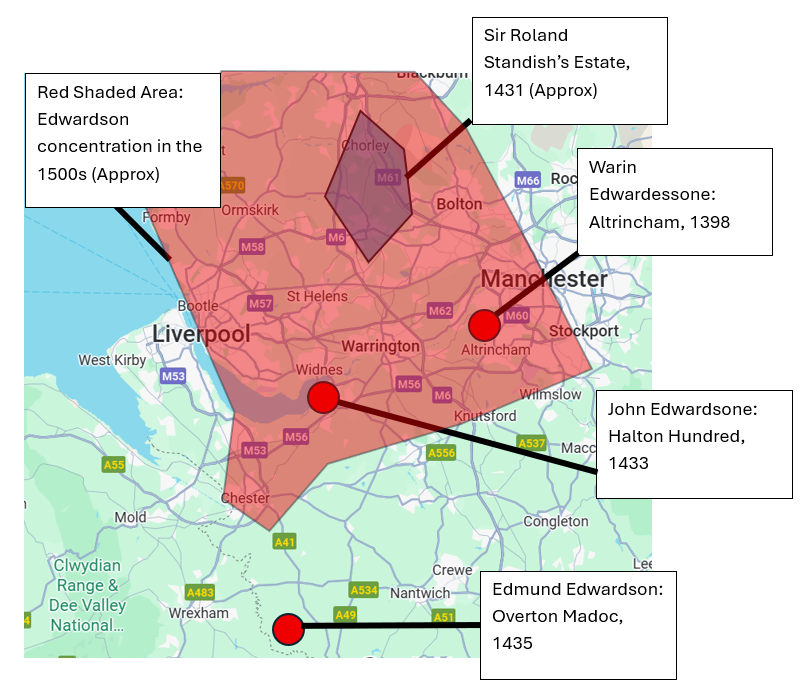
From previous research, it’s clear that the Edwardson name was concentrated strongly in Lancashire and neighbouring parts of North Cheshire from at least the 1500s. We can tell this largely because of parish registers, which were mandated to be kept in every parish by Thomas Cromwell from the 1540s, providing records of baptisms, marriages and deaths even for common folk. But before this point there is little evidence to record the names of most ordinary people; the Medieval Soldier Database is a valuable exception.
The databases’ sources reveal a handful of Edwardsons from the 1400s; men who appear in a few obscure records briefly and faintly like fleeting ghosts. Let’s break them down each in turn, to see what they can tell us about the surnames’ distant past:
Warin Edwardessone
Role: Man-at-Arms in King Richard II’s Chehsire Bodyguard
Location: Altrincham, Cheshire
Dates Mentioned: 1397 – 1398
Sources:
'Welsh Records: Recognizance Rolls of Chester' in Annual Report of the Deputy Keeper of the Public Records 36 (1875), p.166’
And
‘Roll of payments to soldiers with names’ - TNA, E101/42/10, m2 (from the Medieval Soldier database) 29 July 1398
Warin has a full profile on the Edwardson History Society website which explores his historical context – and he is the earliest verified person named Edwardson currently findable in the historical record. As a Man-at-Arms in King Richard II’s bodyguard, it is reasonable to assume that he was at least a very well-off yeoman or even a minor gentleman, because he must have been able to afford the weapons, armour and horses that made a credible Man-at-Arms. He likely owned his own land in the Altrincham area or was the direct tenant of a prominent local lord. So, from him we can tell that some Edwardsons of the 1390s were relatively well-off, even having royal patronage (although this may not have survived Richard II’s downfall) and that they were already present in the Lancashire-Cheshire border area where they would later be concentrated in the 1500s. Warin’s ultimate fate is a mystery – if he survived his King’s downfall, then he may have subsequently joined Henry Hotspur’s rebellion, as did many Cheshire men who had previously served Richard II. They were to suffer heavy casualties in their defeat at the Battle of Shrewsbury in 1403 – was Warin amongst them?
John ‘Edowersson’
Role: Man-at-Arms under Sir Roland Standish, Garrison of Louviers
Location: Louviers, Normandy; and likely on or near to Sir Roland Standish’s estates centred on Duxbery Hall, Chorley.
Date Mentioned: 28 Nov 1431
Source: Muster Roll: BNF, MS. Fr. 25770, no. 652
John ‘Edowersson’ (almost certainly a phonetic spelling of Edwardson) was serving under Sir Roland Standish in 1431, part of the English garrison in Normandy when the tide of the Hundred Years’ War was turning against England. Again, he was a Man-at-Arms, not an archer, so presumably he was of a similar status to Warin. Also, Sir Roland was a Lancashire Knight based at Duxbery Hall near Chorley. He would almost certainly have recruited his Men-at-Arms from his own estates or from his immediate neighbours through a local network of patronage. This makes it highly likely that John hailed from Lancashire or a neighbouring part of Cheshire, within Sir Roland's network.
John Edwardsone
Role: Unknown – Yeoman or Minor Gent?
Location: ‘Neuton in Halton Hundred’ (likely Newton-by-Daresbury, a village long absorbed into Daresbury in the Borough of Halton, near Runcorn)
Date Mentioned: 24 April 1433
Source: 'Welsh Records: Recognizance Rolls of Chester' in Annual Report of the Deputy Keeper of the Public Records 37 (1876), p. 255
‘24 April 1433 recognizance of 4 marks paid by John Edwardsone of Neuton in Halton Hundred to John del Dedwode’.
This is all the record tells us of John, but it might let on more than it first seems to. Firstly, he was of ‘Neuton in Halton Hundred’ – almost certainly near modern Runcorn. This is again within the Lancashire-Cheshire home of the later Edwardsons – indeed, it is just across the Mersey from Widnes, where a great number of Edwardsons have been concentrated from the 1500s to the present day. This is evidence that they were already there in the 1430s.
Next, John owed 4 Marks to one John del Dedwode. It is unclear who exactly Dedwode was, but there is some evidence that the Dedwodes were major land owners around Chester in the 1430s and served as local mayors and sheriffs. Plenty of other men are recorded as owing Dedwode money in the recognizance roles. 4 Marks was about £2.63 in 1433, or (very roughly) £16,000 in today’s value. This was no mean sum, representing around half a year’s wage for a skilled labourer at the time. John must therefore have been a minor gentleman or very substantial yeoman with significant interests. This, of course, was not an amount to be left unpaid to a prominent county landowner. The record does not necessarily confirm that John paid the money – only that he owed it to Dedwode. Therefore, we can say that John was living in the later Edwardson heartland, and that he had incurred a significant financial debt to a prominent local figure.
Another thought naturally occurs – was John Edwardsone the same man as ‘John Edowersson’, the Man-at-Arms serving in France just two years earlier? It is not impossible. Runcorn was only a day’s walk from the estates of Sir Roland Standish, less on horseback – it is perfectly conceivable that Sir Roland could have recruited a Man-at-Arms living near Runcorn into his retinue. Of course, John was a very common name at the time just as it is now, so it’s plausible that two different John Edwardsons lived at the same time a short distance from one another.
But if this was the same John, then there is (again) an uncomfortable question over his fate. For Sir Roland Standish was to return to France to fight under John Fitz Alan, Earl of Arundel, in 1435. At the Battle of Gerberoy, Fitz Alan’s army was smashed in a French surprise attack; Fitz Alan himself was wounded and died in captivity, and Sir Roland himself was reportedly killed in the battle. Was John Edwardson with him? Well, we can only speculate, but if John’s debt to Dedwode had caused him financial difficulty, perhaps he took arms with Standish in the hope of acquiring valuable plunder on campaign. If this was the case, John may have been slain on the field beside his lord and hundreds of other English soldiers – a few feet of French soil his only prize.
Edmund Edwardson
Role: Collector of the Subsidy
Location: Overton-Madock (likely modern Overton-on-Dee near the Anglo-Welsh border)
Date Mentioned: 14 April 1435
Source: 'Welsh Records: Recognizance Rolls of Chester' in Annual Report of the Deputy Keeper of the Public Records 37 (1876), p. 255
‘14 April 1435 appointment of Edmund Edwardson and Jankyn Davidson as collectors of the subsidy in Overton-Madoc’
Again, a short source but a potentially revealing one. Edmund Edwardson’s appointment as ‘collector of the subsidy’ tells us that he was appointed, by the Cheshire County authorities, to collect a specific tax in the Overton area. This was a job usually given to a local gentleman or burgess (civic leader). It was a position of trust, since the collector was held personally responsible for collecting the correct amount of tax and accounting for it at the Cheshire Exchequer. So, this job implies a man of status and good local connections, as well as (hopefully) trustworthiness. And, again, we are in Cheshire (Overton, now in Wales, was then administered by Cheshire), a short journey south from the locations at which we find the previously mentioned Edwardsons.
Robert Edwardson
Role: Archer
Location: Acquitaine (South-West France) – Possibly also Flintshire/Cheshire, or Burton Pedwardine, Lincolnshire
Date Mentioned: 29 June 1439 (Possibly also 1432)
Source: Muster Roll TNA, E101/53/22, m4 (Medieval Soldier Database)
Robert’s position as an archer marks something of a downgrade compared with the status of the previous Edwardsons – but not necessarily a significant one. Archers (longbowmen) were still likely of yeoman rank – for they needed the modest wealth to kit themselves out (with bow, side-arms, and light armour) and to have had the free time to train consistently over the years to become credible archers (developing the strength and skill required took years of practice from boyhood on). Robert need not represent a significant drop in the Edwardson fortunes, or a less well-to-do branch of the family. He may just as likely have been a younger son or cousin to the most well-off Edwardsons, seeking to make his own name through military service, but not quite able to afford the requirements of a Man-at-Arms.
We are not given a location for him, but his Captain, the prominent Knight Sir Thomas Rempstone, was High Sheriff of Flintshire and High Constable for life of Flint Castle (amongst other titles). It stands to reason that he may have recruited archers from the North-East Wales area. Given that Edmund Edwardson was collecting taxes on the Welsh border only four years before, it seems most likely that Robert hailed from a similar area – West Cheshire or thereabouts – and was recruited through Rempstone’s Flintshire network. However, one of Rempstone’s other likely recruiting areas was his ancestral estates in the East Midlands – not far from Burton Pedwardine, Lincolnshire, where a ‘Robert Edwardson’ was witness to an ‘Inquisition Postmortem’ (local inquiries into valuable properties) in 1432. Perhaps this was a same man – which would spoil the unto now neat concentration in the North-West. Either is possible, but the evidence to make one origin more likely than the other simply isn’t available.
Raulyn Edwardson
Role: Archer
Location: France (likely Normandy)
Date Mentioned: 17 July 1443
Source: Muster Roll TNA, E101/54/5, m4 (Medieval Soldier Database)
Raulyn is listed as being part of an expeditionary force under the overall command of John Beaufort, Duke of Somerset. Unfortunately, this was to be no glorious campaign but rather an infamously pointless operation in which the (probably ill and seriously depressed) Beaufort led 7,000 men aimlessly through Gascony and Maine while his logistical chain crumbled. Many soldiers deserted or were killed by the French – but there is some hope that Raulyn survived given that his Lieutenant is listed as Sir Thomas Kyriell. Kyriell survived the campaign and would live long enough to lose his head during the Wars of the Roses. We can only hope that Raulyn stuck close to his commander and made it back to safety with him. Raulyn has no point of origin specified, and the troops for this expedition were recruited nationally. However, taking all the previous evidence into account, it seems most likely to surmise that Raulyn also came from Cheshire or Lancashire – there is no evidence to suggest that he was based elsewhere, and the region was always a rich source of archers. He, too, was likely from a yeoman family and looking to join a campaign to advance his own prospects in life. In this campaign at least, his ambitions were almost certainly thwarted.
Analysis
Having run through all these Medieval Edwardsons, what can we say? Well, almost all the Edwardsons for whom we have a location attached fall within, or in proximity to, the area where the Edwardson surname was most numerous from the 1500s onwards. This suggests that the Edwardson name was already rooted in the area by the 1390s. Given that surnames were still becoming fixed during this period (broadly 1200 – 1450), this is strong evidence that the Edwardson name originated in the Cheshire/Lancashire area (But the mention in Lincolnshire in 1432 should still be noted).
Adding to this evidence is further analysis provided by the academics behind the Medieval Soldier database. They (very kindly) searched the Poll Tax records (from 1377) and were unable to find anyone at all called Edwardson. Of course, Cheshire, as a County Palatine, was exempt from the Poll tax. This suggests two things:
- That the surname Edwardson did not exist outside of Cheshire in the 1370s.
- That the name was therefore extremely rare and localised at the time.
This would explain the paucity of Edwardsons in the historical record during the 1400s – there had been little time for them to multiply. Indeed, it would suggest that the Edwardson named was held by only a few individuals in Cheshire in the late 1300s, and that during the 1400s it branched out into neighbouring parts of Lancashire, where, by the 1500s, it had become most numerous.
Socially, the Edwardsons cited above appear to have been broadly of yeoman class, either on the cusp of being gentlemen (Warin and John, who were classed as Men-at-Arms, and Edmund the Tax Collector) or lesser yeomanry (the archers Robert and Raulyn). This implies that the Edwardson name first became fixed amongst individuals who by the 1300s were freemen, not serfs, owning their own property and occupying a respected place in the local social network.
This is very much speculation, but taking everything together – the rarity of the name, its geographic isolation, its social status – it is tempting to suggest that the Edwardson name began as a moniker which asserted descent from a specific individual called Edward. Perhaps he was a prominent figure of some kind, and the ‘sons of Edward’ were his children (or, if he was a noble or gentleman, perhaps his bastard children to whom he gave minor lands).
But that could be reading too much into limited evidence – Edwardson could simply have been a rare name adopted by the sons of some local yeoman who stood out because they were called Edward, in locales where nobody else had that name. Either way, we just don’t have the evidence to confirm or disprove any theory.
For now, these Edwardsons are the earliest possible ancestors I can point to. Perhaps new evidence will appear to dispel the gathered mists of centuries and bring their story back into the light? Until then, my quest continues.
With thanks to Professors Anne Curry and Jason Sadler at The University of Southampton, and Adrian Bell at The University of Reading.
